
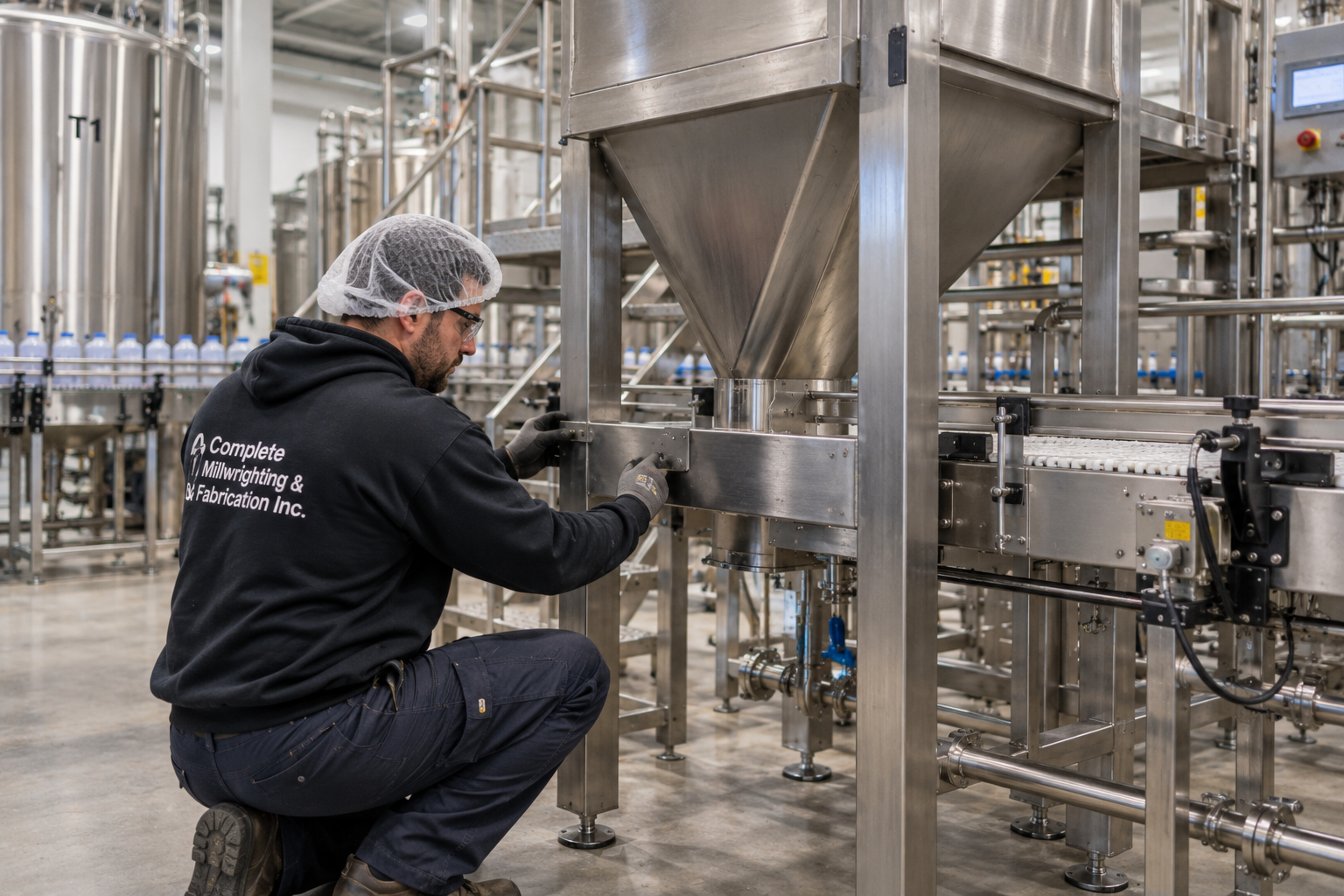
Choosing stainless steel does not by itself make a fabricated component suitable for a food or beverage production environment. Material selection matters, but geometry, joints, drainage, surface condition, cleaning access, fit-up and compatibility with plant procedures also influence whether the finished component is suitable for its intended application.
Effective sanitary stainless steel fabrication starts by understanding how the component will be used, what it will be exposed to, how it will be cleaned and how it must integrate with existing production equipment. These decisions should be addressed before fabrication begins, rather than after material has already been cut.
Start With the Operating Environment, Not Just the Material
Material selection should begin with the actual operating conditions. Product exposure, moisture, cleaning chemicals, corrosion conditions and relevant temperature or process conditions can all influence what the project requires.
Customer specifications are another important consideration. Existing equipment and materials may also affect the decision, particularly when a new component must connect to or operate beside an established production system.
This makes material selection a project-specific decision. The appropriate stainless steel for one food or beverage application may not necessarily be the appropriate choice for another operating under different exposure or cleaning conditions.
304 or 316 Stainless Steel Depends on the Application
Both 304 stainless steel and 316 stainless steel are available fabrication materials. Choosing between them requires consideration of the operating environment rather than assuming that one grade is automatically correct for every sanitary application.
Exposure conditions, cleaning practices, corrosion conditions and customer specifications can all affect the choice. Existing plant equipment may also need to be considered when a fabricated component is being added to an established process.
The common assumption that 316 stainless steel is always the superior choice can oversimplify the decision. The objective is to select material that suits the actual application and the customer’s requirements.
Sanitary Design Starts With Geometry
Correct material selection is only one part of the fabrication problem. A component made from an appropriate stainless steel can still create maintenance or cleaning difficulties if its geometry does not suit the production environment.
Unnecessary horizontal ledges and flat surfaces can create areas where liquids remain. Corners, transitions and spaces around supports can also affect access. Drainage and the ability to reach relevant areas for cleaning or inspection should therefore be considered during design.
Integration with surrounding machinery matters as well. A component may have accessible surfaces when viewed by itself but become difficult to reach once installed beside conveyors, tanks, platforms or other production equipment.
This is why stainless steel and sanitary fabrication should consider material, geometry, joints, cleaning access and the operating environment together.
Joints, Gaps and Inaccessible Areas Need Attention
Seams, joints, gaps and overlapping components deserve careful consideration in food and beverage fabrication projects. Difficult-to-access transitions and connections to existing equipment can create additional cleaning and inspection challenges.
These details become particularly important when a new component must fit closely against existing machinery or structures. A design that appears straightforward before installation may create inaccessible areas once all surrounding equipment is considered.
The goal during planning is to identify these conditions and determine how the component should be fabricated and integrated for its intended environment. No particular material or fabrication method by itself guarantees regulatory compliance or eliminates contamination risks.
Weld Quality and Finishing Affect the Finished Component
Welding and finishing decisions affect the fit, condition, accessibility and cleanability of the completed component. Weld location and the way fabricated sections come together can influence how easily surfaces and transitions can be accessed after installation.
Complete Millwrighting & Fabrication Inc. works with CWB-qualified welders and capabilities that include GTAW / TIG welding, SMAW / stick welding, and shop and onsite welding. The appropriate process depends on the component, material, location and project requirements.
CWB qualification should not be treated as a sanitary certification. Similarly, surface-finish requirements and other project-specific fabrication criteria should be established from customer requirements rather than assumed based solely on the intended industry.
Existing Equipment Changes the Fabrication Problem
Food processing stainless steel fabrication frequently involves integrating a new component into an existing production line. That makes field conditions an important part of fabrication planning.
Field measurements can be necessary to confirm existing equipment dimensions and installation clearances. Adjacent conveyors, machinery, platforms and structural components may restrict access or influence the size and shape of the new fabrication.
Fit-up can also become more complicated when existing equipment differs from available drawings or when several components must meet at a specific location. Equipment modifications and final adjustments may therefore need to be considered as part of the project scope.
A seemingly simple rack, chute, platform or equipment modification can require significant planning when it must fit accurately into an established production layout.
The Plant’s Sanitation Procedures Matter During Onsite Work
Work performed inside a food or beverage facility has to account for more than fabrication and installation requirements. The customer’s production and sanitation procedures can affect how onsite activities are planned and coordinated.
Standard Operating Procedures (SOPs), Good Manufacturing Practices (GMPs) and site-specific sanitation requirements should be understood before work begins. These requirements can influence access, work areas, sequencing and coordination with plant personnel.
Our food and beverage processing capability includes HACCP-educated workers who can work within customer requirements and plant procedures. Complete Millwrighting & Fabrication Inc. does not rely on that terminology as a substitute for understanding the specific requirements of each facility.
Early communication is important because procedures can vary between customers and production environments.
Sanitary Fabrication Can Take Many Forms
Stainless steel fabrication for food plants can include racks, carts, platforms, tanks, hoppers, chutes, conveyors, process components and equipment modifications. Each presents a different combination of operating, cleaning and installation considerations.
A cart, for example, has different functional requirements from a hopper integrated into production equipment. A platform must account for its relationship to surrounding machinery and access, while a chute may require particular attention to geometry, transitions and its connections to adjacent equipment.
The fact that each component is fabricated from stainless steel does not make its requirements identical. Function, exposure, cleaning needs, geometry and integration should guide the fabrication approach.
Decide What Belongs in the Shop and What Must Happen Onsite
Some components can be substantially fabricated in the shop before being delivered for installation. Shop fabrication can allow work to proceed before the installation window, provided the required dimensions and project information are available.
Other aspects of the work depend on field conditions. Measurement, fit-up, modification, installation, integration and final adjustments may need to occur at the facility, especially when a component interfaces directly with existing production equipment.
The appropriate division depends on the component, facility access and confidence in the available dimensions. Custom industrial fabrication and welding can therefore involve both shop fabrication and onsite work when a component must be integrated into an existing plant environment.
Determining this division early also helps the project team understand what needs to be completed before the installation date and what must be addressed during the onsite work window.
Review the Fabrication Requirements Before Material Is Cut
Sanitary fabrication planning should begin before material reaches the shop floor. The contractor and customer should have enough information to understand the material requirements, dimensions, intended function, operating environment and cleaning requirements.
Customer specifications, existing equipment, access conditions, installation requirements and integration constraints should also be reviewed. Field measurements may be necessary where the fabrication depends on existing machinery or facility conditions.
Resolving these requirements early can reduce avoidable changes after fabrication is underway. More importantly, it keeps the project focused on the complete application rather than treating stainless steel selection as the only decision that determines suitability.
Food and beverage facilities planning stainless steel fabrication, equipment modifications or production-area components can Request a Project Review by providing the available dimensions, material requirements, operating conditions, cleaning requirements and installation information for review.